

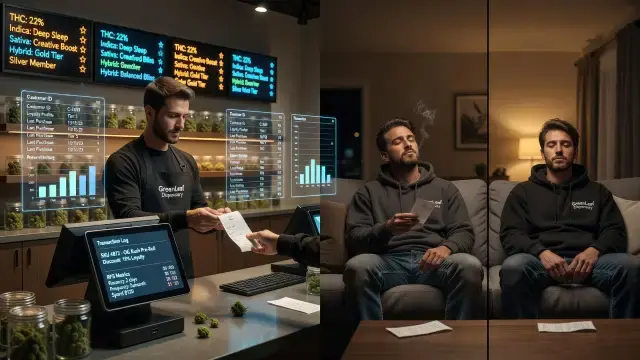
April 20 is to cannabis retail what Black Friday is to general merchandise - the single highest-volume sales day of the year, when every POS terminal, e-commerce menu, and inventory system faces its stiffest test. This year, that test broke Dutchie for a significant share of its more than 6,000 licensed retail clients in the U.S. and Canada. Hours-long outages halted transactions, wiped out preorders, and sent customers away from stores that had no ability to process sales, count inventory, or access back-office compliance functions.
What Operators Actually Experienced
At Pure Cannabis Outlet in Michigan, the Dutchie POS system was down for more than five hours. Operations manager Jerry Hicks described workers who couldn't log in to accounts, couldn't pull inventory data, and couldn't check out a single customer. "We had so many angry and disappointed customers, and we were literally helpless," he said. That's not a minor inconvenience - a five-hour POS outage on 4/20 is, operationally speaking, a total shutdown. Without system access, staff can't verify purchase limits, pull compliance logs, or generate the transaction records that regulators require. In many states, selling cannabis without a functioning seed-to-sale-connected POS isn't just operationally difficult; it's a compliance violation waiting to happen.
Curio Wellness co-founder Wendy Bronfein reported a harder number: roughly $80,000 in estimated lost sales across multiple Maryland locations, plus nearly 1,000 cancelled preorders - cancelled, notably, to remain in compliance, not just to manage the queue. Staffers couldn't fulfill orders the system could no longer verify. Bronfein drew a comparison that should land with any cannabis operator: "This is equivalent to Walmart's systems being down on Black Friday, or Amazon experiencing payment issues on Prime Day." The analogy isn't overblown. The structural stakes are identical, even if cannabis retailers are operating under a regulatory overlay that Walmart and Amazon never face.
Dutchie's Response - and What It Actually Says
Dutchie CTO Chris Ostrowski acknowledged the failures while contextualizing them within what the company called a record-setting day. The platform processed over 2 million transactions and $165 million in retail commerce on April 20 - a 50% increase from the same day in 2023. In Dutchie's framing, the outage affected "a group of customers local to a specific instance" of its POS system. That language is technically precise but operationally cold comfort to store managers who spent five hours turning away customers.
Here's the catch: this is the second consecutive year Dutchie has faced a significant 4/20 system failure. In 2023, a cascade of failures between Dutchie's systems and retail e-commerce menus caused widespread outages across hundreds - potentially thousands - of stores. The company acknowledged those failures and promised payouts to affected retailers. Twelve months later, a different architecture problem produced similar outcomes for a subset of clients. Two years running is a pattern, not an anomaly, and the industry will treat it as one regardless of how Dutchie characterizes the scope.
Infrastructure, Compliance, and the Real Cost of Downtime
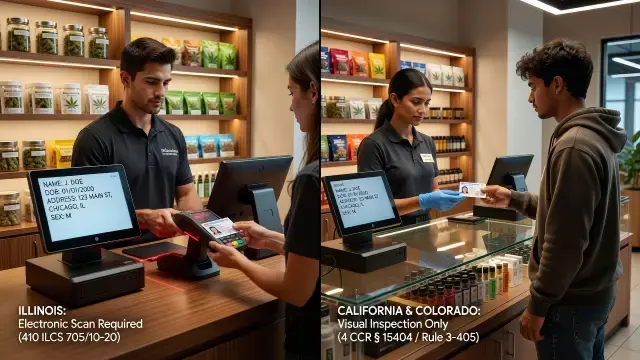
Cannabis retail operates under compliance constraints that most general retail does not. In regulated states, dispensary POS systems are typically integrated - directly or via middleware - with state tracking platforms like METRC. Every transaction is logged. Purchase limits are enforced at the point of sale. Inventory adjustments feed into compliance reporting. When a POS crashes, it doesn't just stop revenue; it creates a gap in the compliance record that operators then have to reconcile manually or explain to regulators. That's hours of administrative work stacked on top of an already chaotic day.
Multi-state operators carrying a vertical integration footprint - their own cultivation, processing, and retail - face compounded exposure. A sales outage doesn't just affect retail revenue; it can distort the wholesale pipeline and downstream inventory reporting across the entire operation. Smaller single-location dispensaries, meanwhile, often have no fallback system and no dedicated IT support to triage a mid-shift POS failure.
Bobby Fikree, a principal partner at MacGyver Consulting - a Toronto-based retail marketing and e-commerce firm working with 30-40 cannabis stores across the U.S. and Canada - noted that retailers who had implemented recommended technological upgrades reported no downtime on 4/20. That's a meaningful data point. The question of what those upgrades specifically entail matters; redundant systems, failover protocols, and POS configurations that don't rely on a single cloud instance are the kinds of infrastructure investments that turn a catastrophic outage into a manageable blip. The retailers who made those investments survived the day. Those who didn't paid the price.
The Broader Reform Argument - and Why It's Gaining Traction
Bronfein used the outage to re-litigate a structural argument the cannabis industry has been making for years: the absence of mainstream banking access and SAFER Banking reform leaves dispensaries overly dependent on narrow, industry-specific payment infrastructure with no fallback options. The argument has real weight. Because cannabis remains federally illegal, most major payment networks won't process cannabis transactions directly. Dispensaries operate largely in cash or through workaround solutions - cashless ATMs, PIN debit systems, cannabis-specific payment platforms - that layer technical complexity and single-point-of-failure risk on top of an already fragile payments stack.
A general retailer facing a POS failure can pivot to a backup payment terminal, tap a different processor, or accept cards through a completely separate system. Cannabis retailers often can't. Their payment options are narrower, their vendor pool is smaller, and the compliance requirements attached to each transaction mean there's no clean analog to just "running transactions manually" until the system comes back up. That's the structural vulnerability Bronfein is pointing at - and it's a legitimate one.
Whether SAFER Banking would have prevented Saturday's outage specifically is a separate question. Dutchie's failure appears to have been a platform infrastructure problem, not a payments processing failure. But the broader point - that cannabis retailers need more resilient, diversified technology and payment infrastructure - is hard to argue against after two consecutive years of 4/20 outages.
For dispensary operators reviewing vendor contracts this week, the practical implication is straightforward: what does your SLA actually guarantee, what's the compensation mechanism when a vendor fails on your highest-volume day, and do you have any fallback at all when the primary system goes down? If the answer to that last question is no, that's the problem to solve before next April.